
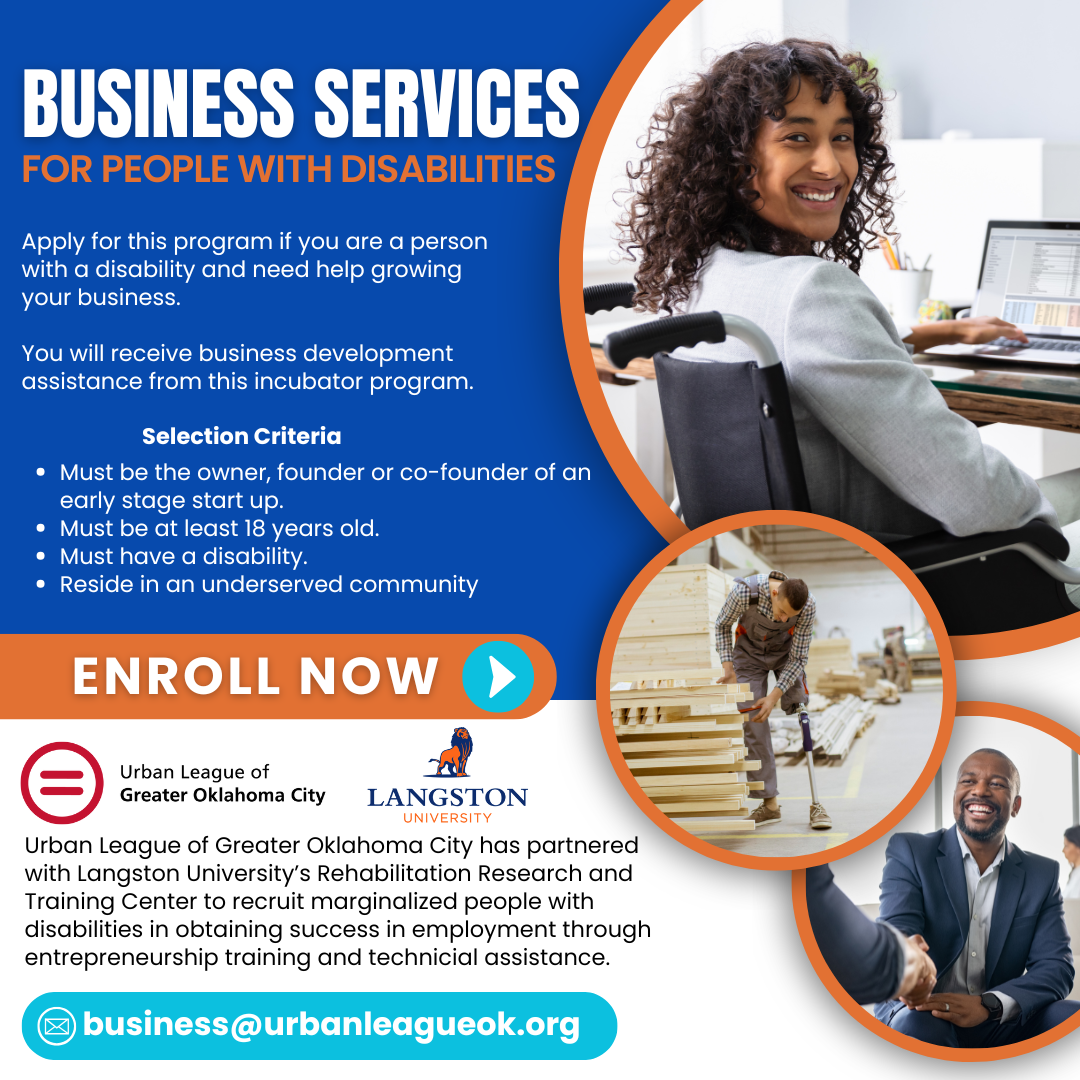
The Urban League of Greater Oklahoma City has partnered with Langston University’s Rehabilitation Research and Training Center to recruit marginalized people with disabilities in obtaining success in employment through entrepreneurship training and technical assistance. By recruiting numerous marginalized people with disabilities interested in starting or sustaining their small minority-owned business, the Urban League has will help to grow businesses within the entire State of Oklahoma, especially those people of color.
Eligibility Criteria
- Be a founder, co-founder, or leader of an early-stage startup,
- Have the desire to receive incubator services (e.g., mentoring)
- Willingness to be held accountable to project goals.
Selection Criteria
- Must be 18 years and above.
- Must show interest in entrepreneurship.
- Must have a disability.
- Must be from an underserved community.
- Potential for solving the identified problem at scale.
- Must submit complete application.
To begin the application process, you must complete an intake form and survey. Simply scan the QR code below or click on the link to complete our intake form https://forms.gle/
A disability is a condition that substantially limits one or more of your “major life activities.” If you have or have ever had such a condition, you are a person with a disability. Disabilities include, but are not limited to:
– Alcohol or other substance use disorder (not currently using drugs illegally)
– Autoimmune disorder, for example, lupus, fibromyalgia, rheumatoid arthritis, HIV/AIDS
– Blind or low vision
– Cancer (past or present)
– Cardiovascular or heart disease
– Celiac disease
– Cerebral palsy
– Deaf or serious difficulty hearing
– Diabetes
– Disfigurement, for example, disfigurement caused by burns, wounds, accidents, or congenital disorders
– Epilepsy or other seizure disorder
– Gastrointestinal disorders, for example, Crohn’s disease, irritable bowel syndrome
– Intellectual or developmental disability
– Mental health conditions, for example, depression, bipolar disorder, anxiety disorder, schizophrenia, PTSD
– Missing limbs or partially missing limbs
– Mobility impairment, benefiting from the use of a wheelchair, scooter, walker, leg brace(s) and/or other supports
– Nervous system condition, for example, migraine headaches, Parkinson’s disease, multiple sclerosis (MS)
– Neurodivergence, for example, attention-deficit/hyperactivity disorder (ADHD), autism spectrum disorder, dyslexia, dyspraxia, other learning disabilities
– Partial or complete paralysis (any cause)
– Pulmonary or respiratory conditions (for example, tuberculosis, asthma, emphysema)
– Short stature (dwarfism)
– Traumatic brain injury


Questions, please email business@urbanleagueok.org.